Provide direction
Explain project types, scale, location, stage and working methods in words that someone who is not an architect can understand.
Portfolio · editorial architecture · enquiries
A website for architects needs to show visual judgement without hiding the information that helps people choose: the kinds of commissions the practice takes on, how it makes decisions, its role in each project and how to start a useful conversation.
Direct answer
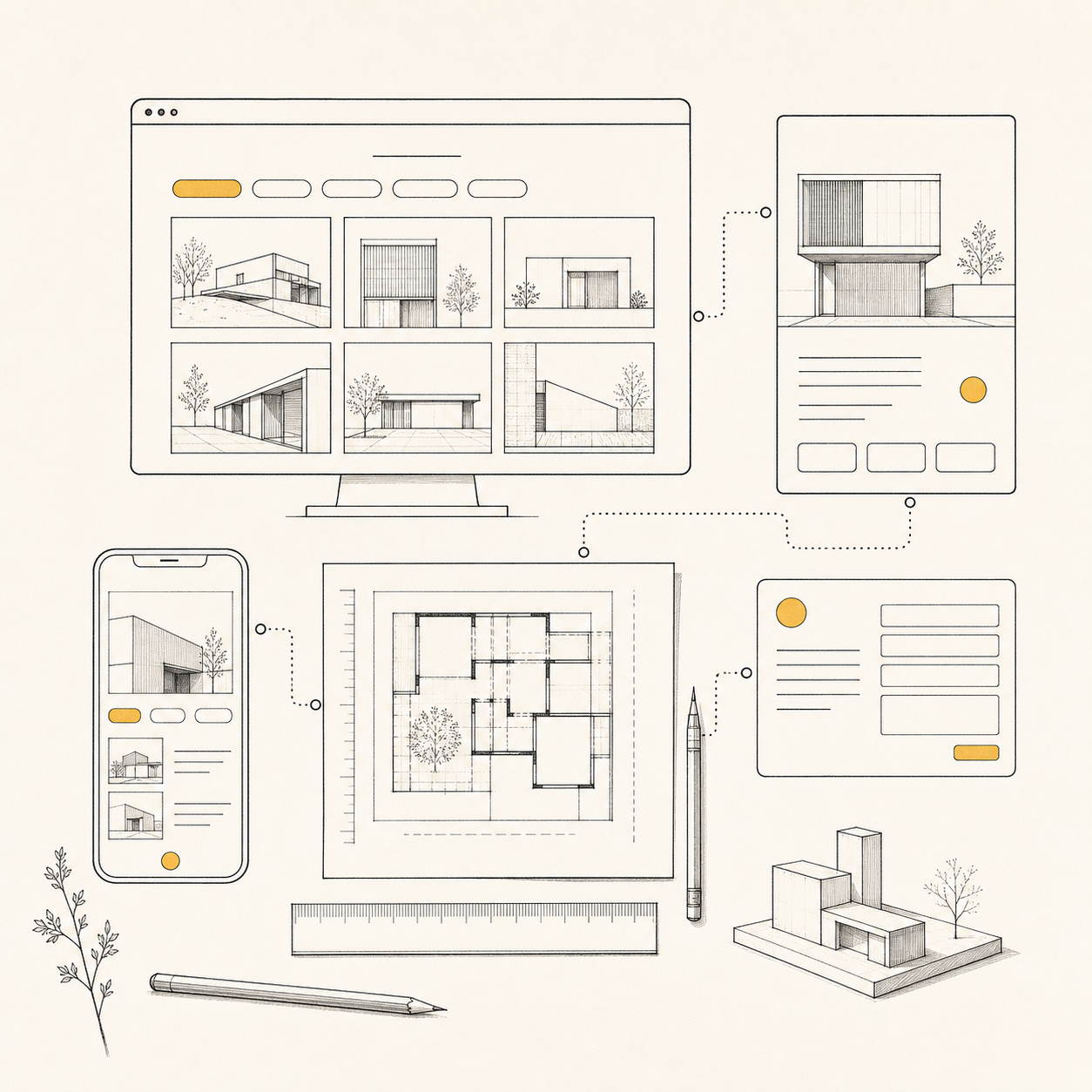
A good website for architects is not an endless sequence of images. It is an editorial system that helps visitors find relevant projects, understand the challenge and design decision, check authorship and credits, and move towards making contact, requesting a dossier or collaborating without getting lost.
Search results for ‘websites for architects’ are dominated by guides and examples. That is why this page first answers how to structure the portfolio, then explains how I can turn those principles into a website for a practice in Mallorca.
Before choosing an aesthetic
If everything is reduced to a grid of photographs, visitors may admire the practice and still not know whether it is right for their commission.
Explain project types, scale, location, stage and working methods in words that someone who is not an architect can understand.
Connect constraints, decisions and outcomes. The image attracts attention; the context reveals why the project matters.
Make clear the practice's role, collaborators, photography, project status and which details can be published.
Offer a different next step for a private client, competition team, publication, developer or potential collaborator.
Portfolio architecture
A practice with six selected works may not need filters. One with thirty projects may need type, status or scale. Location and year only help if visitors use them to compare.
I would avoid empty categories, internal labels and combinations that return a single result. I would also provide a ‘selection’ view for anyone who does not want to explore the entire archive.
A useful project profile would not invent results: it would organise verifiable information so the reader can understand the problem and the response.
Starting conditions, constraints and the objective of the commission.
One or two design choices explained without unnecessary jargon.
Status, year, location, area or programme, only when they can be published.
The practice's role, collaborators, photography, renders and verifiable recognition.
Local tool
Choose six conditions for the practice. The result suggests filters, a project profile structure, visual balance, SEO, enquiry routes and an initial deliverable. It is editorial guidance; it does not replace an inventory, interviews, permissions or a technical audit.
Runs in your browser. It does not send your answers or generate a quote.
Recommended initial architecture
Use it as a working hypothesis when reviewing your real material. Do not publish fields without confirming permissions and facts.
Project depth
‘A bright, contemporary home’ could describe almost any image. It is more useful to document the existing condition, the decision the practice made and which part of the outcome can be verified.
Programme, constraints, relationship with the site, previous condition or regulatory requirements, described to the extent they can be published.
A spatial, material, environmental or functional strategy. Plans and diagrams should support that explanation, not decorate the page.
Status, dates, area, role, collaborators and credits. Budget, savings or performance only with a source, permission and methodology.
Photography, plans and renders
The homepage can load one priority image; the rest should adapt to the actual width, declare their dimensions and load as they approach the viewport. A full-screen photograph and a thumbnail do not need the same file.
Before compressing, decide the sequence: overview, spatial decision, detail, plan or process. This avoids publishing twenty assets with no hierarchy.
Local SEO and editorial architecture
The search engine needs to understand the practice, its services, locations and projects; the visitor needs to decide whether there is a fit. Both improve when information is clearly separated and linked.
The name, specialism, contact details and actual presence should be consistent across the website and Business Profile. The local SEO in Mallorca page explores that layer in more detail.
Housing, renovation or interiors only deserve their own URL when there is material, a distinct need and enough explanation.
Each project profile needs a stable URL, title, H1, metadata, breadcrumbs and links to the project type, service or practice without forced repetition.
Quality that a screenshot cannot show
Who authorises each photograph, plan or render, on which channels and with what attribution. A website cannot fix permission that was never requested.
The practice, collaborators, photography, engineering, landscape design and project status. Recognition is only shown if it is verifiable.
Contrast, focus, keyboard navigation, alternative text, named controls and reduced motion without sacrificing visual direction.
Markets and audiences
A multilingual website must decide which services and projects are relevant to each market, maintain crawlable URLs and coordinate canonical and hreflang tags. Translating only the menu creates an incomplete experience.
Conversion also changes. A private client needs to understand the process and next step; a competition team looks for capabilities and documentation; a publication needs images, credits and details ready to cite.
A short brief covering the type of commission, location, status and decision stage. No requests for plans or sensitive data in the first form.
A selection by experience, role and scale; access to an up-to-date dossier and a clear route to propose teaming up.
Summary, details, credits, contact and terms of use. Downloads only when rights and resolution have been agreed.
Web design for practices in Mallorca
I can work on the architecture, interface direction, templates, CMS, performance and measurement. The project is defined after reviewing materials, permissions, languages and responsibilities; I do not assume the entire archive is ready to publish.
Projects, audiences, assets, rights, current website and objectives.
Selection, filters, project profiles, user journeys, taxonomies and prototype.
Components, CMS, responsive layouts, accessibility and uploading a real sample.
Migration, redirects, technical SEO, measurement, training and checks.
If the scope requires custom logic, APIs or a private area, it is coordinated with the web development in Mallorcaservice. Ongoing technical support can then be arranged through website maintenance.
Frequently asked questions
A clearly presented selection of projects, useful filters, project profiles with context and decisions, information about the practice, services, contact details and authorship guidelines. It should also plan for image performance, accessibility, SEO, licences, credits, analytics and maintenance.
Not necessarily. A short, well-explained selection often provides better guidance than an indiscriminate archive. The rest can remain in a filterable archive or in specific dossiers. The decision depends on the type of client, the practice's track record and its objectives.
Only those that help people compare. The most common are type, status, scale, location or year, but they should not be added if they leave categories with a single project or require visitors to understand the practice's internal taxonomy.
Alongside images, it is useful to explain the commission or challenge, relevant constraints, the architectural decision, status, location at the authorised level of precision, the practice's role and credits. Area, budget or timescales are only published when they are verifiable and permission has been given.
With sizes adapted to their container, modern formats where appropriate, declared dimensions, reviewed compression and lazy loading below the first screen. Each asset needs a purpose: images show, captions provide context, and alternative text describes what is needed to understand it.
Yes, if art direction considers performance from the outset. Page weight depends on resolution, format, compression, number of assets, videos, fonts and scripts. The actual templates are tested on mobile; optimising an empty homepage is not enough.
Through a consistent entity and contact details, a clear service page, well-described projects and areas of work, internal linking and a properly managed Google profile. I do not recommend creating repeated local pages without a presence, content or a distinct proposition.
Only when there is enough material and a useful intention behind them. Housing, renovation, interiors, public facilities or urban planning may deserve their own pages if they help people decide and bring together projects, process and specific answers; not if they repeat the same text with one word changed.
With crawlable URLs for each language, editorial translation, a visible language selector, canonical tags and reciprocal hreflang. Proper names, credits and technical details must remain consistent. You also need to decide which projects and services are relevant to each market.
The practice must confirm what it can publish, in which media and for how long. The website must credit photographers, collaborators and authors according to the agreements, avoid unlicensed material and retain a record of permissions. Technical design does not replace that contractual validation.
With discreet, clear user journeys: explain who the practice works for, how a commission starts, what information it needs and the next step. A briefing form can qualify the enquiry without requesting unnecessary data or promising an assessment before reviewing the case.
The foundation can be shared, but each audience needs a different next step. A private client looks for fit and process; a competition team needs capabilities and documentation; a publication wants images, credits and details ready to cite. The architecture should offer these routes without duplicating everything.
It can, if that is part of the scope. First, we need to define who will publish, which fields will be mandatory, how images and credits will be handled and what permissions each user needs. An easy-to-use dashboard requires a clear editorial structure, not just installing a CMS.
There is no responsible figure without knowing the number of templates, projects, languages, migration requirements, art direction, content and integrations. After reviewing the material, I can propose phases, deliverables and an itemised quote, without presenting an automatic estimate as a binding offer.
Next step
Share your current website, the approximate number of projects and the markets you want to reach. I will tell you what should be organised first and what scope a responsible proposal needs.