Find
Name, area, opening hours and contact channels consistent with the local profile.
Healthcare web design with sound judgement
A dental website should help people understand treatments, recognise the team, locate the clinic and request an appointment without friction. I design that journey with verifiable content, a mobile experience, local SEO and measurement, without promising clinical or commercial results.
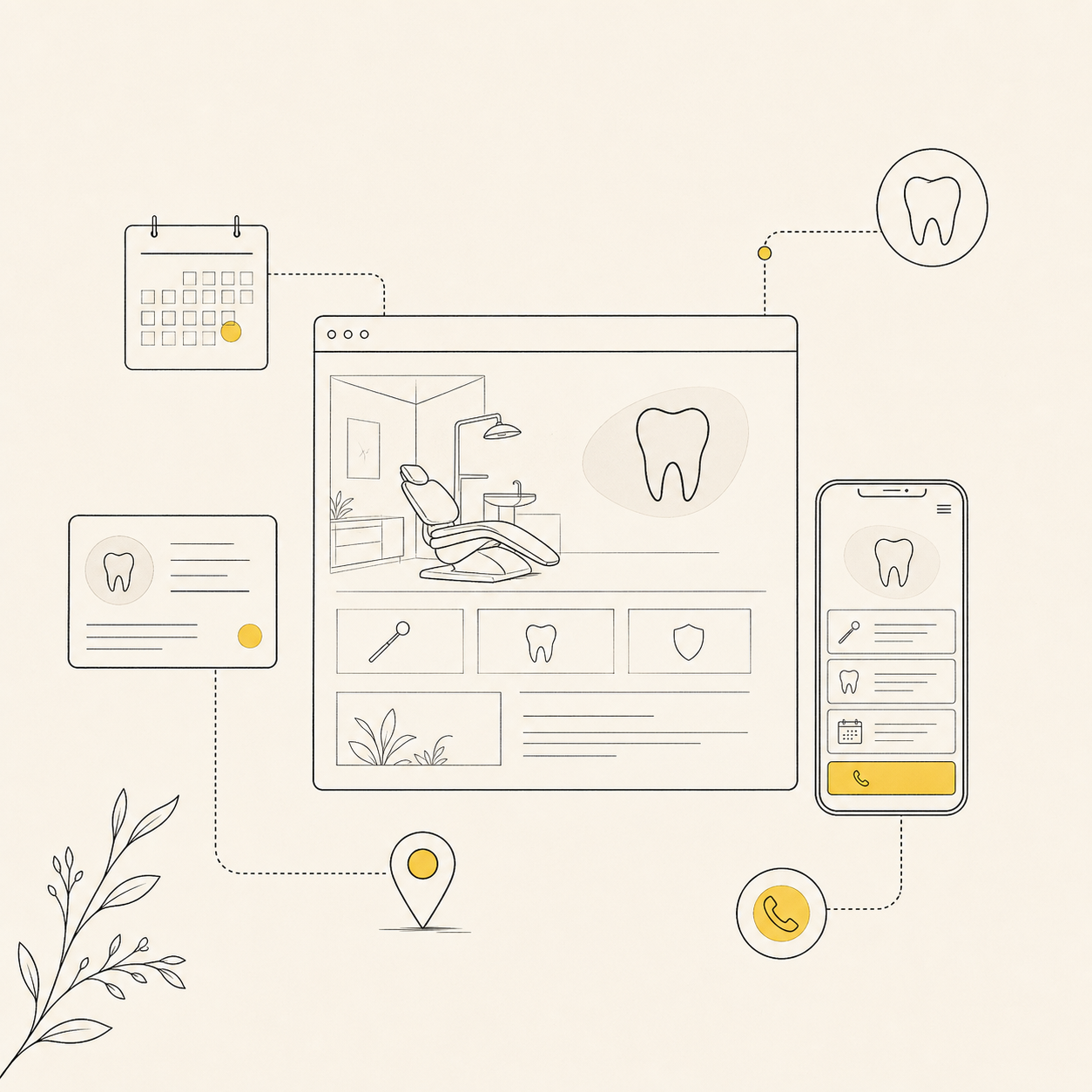
An effective dental clinic website organises treatments and professionals, displays verifiable information, makes location and contact easy, and distinguishes requesting an appointment from confirming it. The foundations should work quickly on mobile, allow measurement with consent and connect with Google Maps without turning the website into a keyword list.
Decision journey
Someone arriving from Google, Maps or a recommendation may be dealing with an urgent issue, comparing a treatment or seeking a second opinion. The architecture should provide context without diagnosing or pushing an appointment.
Name, area, opening hours and contact channels consistent with the local profile.
Treatments explained in useful language, with limitations and a next step.
Team, experience and evidence the clinic itself can verify.
A visible channel explaining whether it sends a request or confirms a time.
Calls, forms and appointments differentiated to avoid inflating conversions.
Architecture by clinic type
The map should reflect the number of locations, the range of treatments and how patients decide. Empty local or clinical pages are not created to occupy more results.
Starting principle: each URL should answer a distinct question and have an owner responsible for keeping treatments, professionals, opening hours and calls to action up to date.
Prioritise the proposition, main treatments, team, access, opening hours, contact and a genuinely useful location page.
Needs a treatment hub and specific pages where intent, questions and the responsible professional differ substantially.
Separate each centre’s local information, available team, opening hours and contact; avoid duplicating the same text with only the municipality changed.
Organise suitability criteria, an indicative process, questions, risks and professional consultation without turning the page into a diagnosis or promising an outcome.
Interactive tool
Tick only the signals you can verify on your website today. You will receive an assessment by area and up to four outstanding priorities.
This is not an audit or healthcare or legal advice. The tool runs in your browser, does not request personal data and does not send your answers.
Content and authority
Docmedia, PubliDental, Updent, Metodoclinic and DND reinforce a clear industry pattern: treatments, team, content, local SEO, mobile and conversion. The gap is connecting those pieces and making it clear what patients can verify.
A page per treatment only makes sense if it answers specific questions, explains the journey and provides an appropriate call to action. The text should be reviewed by the clinic and kept up to date.
Names, roles, training or professional registration are displayed when the clinic can substantiate them. The page does not need to turn every CV into a promise of results.
Reviews must come from a real source; images require permission and context; technologies are not presented as superior without verifiable evidence.
Local SEO and Maps
The Local Pack is part of this search in Palma. The website and Google profile should share consistent data, but they do different jobs: Maps supports discovery and comparison; the website explains treatments, team, access and appointments.
The launch foundations can include local structure, metadata and linking. Ongoing management of profiles, content and authority belongs to a strategy for local SEO in Mallorca.
Correct name, address, phone number, special opening hours and URL across every asset.
Directions, landmarks, access and available treatments without cloned text.
Links or modules from real sources; never ratings written to fill a design.
A call from Maps, a call from the website, a form and a confirmed appointment are not the same event. A review of web analytics can validate that distinction.
Accessibility and privacy
The interface can reduce barriers and the configuration can apply agreed decisions, but no template alone guarantees complete accessibility or legal compliance. Both areas require review, testing and clear responsibilities.
The clinic must validate text, consent, legal bases, retention and appropriate channels with its healthcare and legal professionals. Technical design does not replace that advice.
Method
The project is scoped around real content, technology and validation. A date is only useful when it also assigns who will deliver each asset.
Services, locations, audiences, appointment channels, current technology, analytics, constraints and available content.
A map of treatments, team, locations and questions; relationship with Maps and the hierarchy of decisions on mobile.
Messages, modules, states, forms and review of points requiring healthcare, editorial or legal validation.
Templates, performance, basic technical SEO, viable appointments and measurement according to permissions and providers. Special connections are scoped within web development.
Testing across devices, keyboard use, forms, links, redirects, events and asset ownership, with website maintenance defined when it is part of the scope.
Transparent scope
Final scope is agreed after diagnosis. This distinction avoids attributing clinical, legal, photographic or software work to design when it requires other responsible specialists.
Frequently asked questions
At a minimum, it should explain the clinic, its treatments, verifiable team, location, opening hours, contact channels and how to request an appointment. Mobile use, speed, accessibility, privacy, technical SEO, measurement, maintenance and responsibility for updating information should also be planned.
Not always. A dedicated page makes sense when there is clearly differentiated search intent and a set of questions, a process or a professional. If several pages would end up repeating the same text, grouping them into a more useful architecture is better.
It depends on the provider, plan, documentation, permissions and type of integration available. Before quoting, we need to check whether it offers a link, widget or API, what can be customised and how it handles confirmations, data and measurement.
Not necessarily. Some systems reserve a time slot in real time, while others simply send a request to the team. The interface should explain the status, next step and confirmation channel to avoid creating a false expectation.
With verifiable information: identified professionals, well-explained treatments, consistent location and contact details, authorised photographs, a clear appointment process and honest answers. I do not recommend inventing testimonials, ratings, awards, figures or cases.
Information the clinic can verify and maintain: name, role, areas of work, relevant training and required professional details. Wording should avoid exaggeration and not turn credentials into guarantees of outcomes.
It can include the launch foundations: local architecture, consistent data, metadata, links and useful location pages. Ongoing optimisation of the profile, content, reputation and authority is defined separately as a local SEO strategy.
Each location may need a useful page with its address, opening hours, contact details, access, team or available treatments. Cloning the same text and changing the municipality is not advisable; information should reflect each centre’s reality.
Risk can be reduced with a URL inventory, preservation of valuable content, redirects, metadata, linking and validation before and after launch. Rankings cannot be guaranteed, but a planned migration avoids foreseeable losses.
This is agreed within the scope. I can define architecture, requirements and content guidance, but clinical writing should be prepared or reviewed by qualified responsible professionals. Photography, video, permissions and editorial production are not assumed to be included.
Only what is necessary for the agreed purpose and channel. A general form should not invite medical history or sensitive information without a need, safeguards and validated wording. The clinic should review privacy, providers and retention with appropriate advice.
No. The template is only one part. Contrast, keyboard use, focus, forms, errors, alternative text, structure, zoom, content and external components must be reviewed. Any claim of conformity requires a specific scope and testing.
By defining distinct events and checking they work with consent applied. A phone click, a submitted form, a received request and a confirmed appointment represent different steps and should not be reported as equivalent.
There is no universal timeframe. It depends on treatments, locations, templates, content, photographs, reviews, migration, online appointments and validation. After diagnosis, phases, dependencies, owners and acceptance criteria are proposed.
Next step
Tell me how many locations, treatments and appointment channels there are. I will tell you what to clarify before discussing screens.