Home / Web design / Event websites

Event websites in Mallorca

Event web design in Mallorca: choose the solution before building it

An event may need an information page, registration, tickets, a programme, speakers, sponsors, languages and integrations. Before designing screens, I establish whether a platform is enough, an integrated website makes sense, or there is a real reason for custom development.

No imposed platform Clear data and responsibilities A plan before and after the event
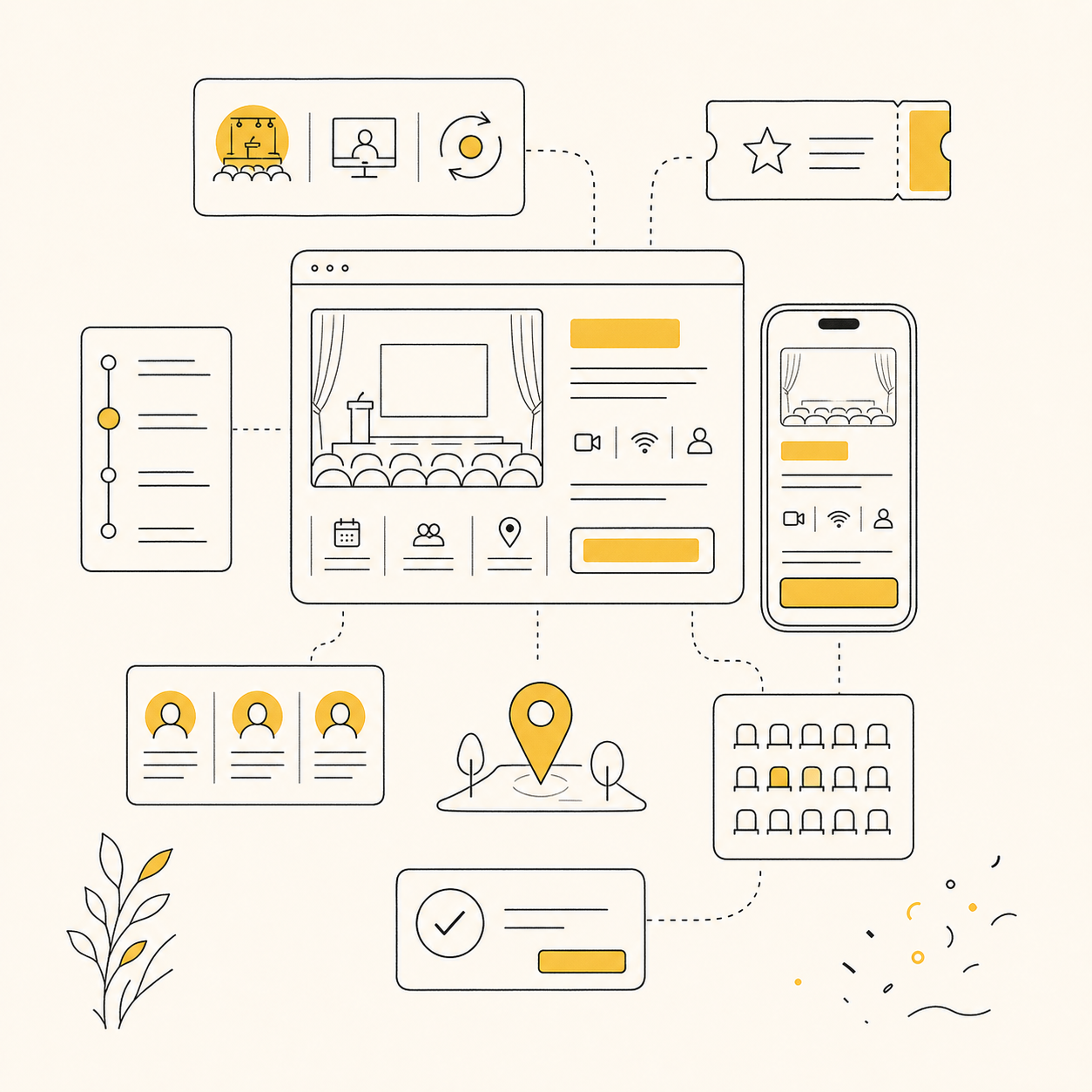
Planning an event website with a programme, tickets, speakers and connected data
Information → registration or purchase → attendance → archive and reuse

First decision

Three valid routes for an event website

Search results are dominated by platforms because many needs are well served by existing products. The useful work is recognising when they are enough, when they need your own layer and when the rules justify development.

01 · Standard platform

Publish and register without building a system

May suit one-off events with conventional needs and operations compatible with the platform's workflow.

  • Page, registration or ticketing within the product.
  • Defined configuration and content.
  • Accepted dependency on templates, data and limits.
02 · Your own integrated website

Control the experience and connect operations

May suit projects where brand, SEO, programme and archive live on your own website, while registration or payments use a specialist solution.

  • Your own URL, content, navigation and analytics.
  • A defined widget, link, API or synchronisation.
  • Continuity between campaigns and editions.
03 · Custom solution

Build only what a platform cannot solve

Considered when roles, data, access, logic or critical integrations cannot sustainably fit within an available product.

  • Documented requirements and source of truth.
  • Errors, permissions and support planned.
  • Ownership and maintenance accepted.

Design does not require custom development. A responsible recommendation may conclude that configuring a platform is enough. Where APIs, portals or bespoke logic are involved, the scope is separated through web development so complexity is not hidden inside a visual landing page.

Decision tool

Event solution selector

Turn nine project characteristics into a shortlist and checklist. This does not calculate a budget or replace a review of the platform, documentation, data, payments or load.

Describe the event lifecycle
Content it must also manage

Indicative result. Before deciding, review the platform, subscription plan, documentation, responsibilities, data protection, payments and load tests.

Shortlist pending

Complete the six required decisions and tick any additional content you need.

The result will include

  • a primary approach and an alternative;
  • reasons linked to your answers;
  • a checklist for the next conversation.

Functional architecture

The website must support the attendee's decision and the team's operations

An attractive programme does not make up for confusing access; a working checkout does not resolve changes nobody publishes. Every section has a job, an owner and states that need testing.

01

Proposition and context

What it is, whom it is for, when, where, format and why it deserves attention. Without hiding essential information behind registration.

02

Programme and speakers

Times, sessions, tracks, profiles and changes in a structure that works on mobile and makes relevant information easy to find.

03

Access and attendance

Open entry, RSVP, invitation or payment with understandable terms, capacity, confirmation, errors and support.

04

Venue and accessibility

Location, transport, timings, access and participation requirements explained with verifiable information.

05

Sponsorship with a hierarchy

Agreed visibility without turning the experience into a wall of logos; documented levels, links and attribution.

06

Notices and continuity

Changes, reminders, incidents, materials and the next edition connected to real channels and responsibilities.

Time-sensitive SEO

Before, during and after: a URL should not expire unexpectedly

Interest in an event is concentrated, but the page can accumulate links, searches and usefulness. The strategy decides in advance what is updated, archived, reused or redirected.

Before the event

Publish a stable URL with the name, date, place or format, access, available programme and clear answers. Create additional pages only when they have their own intent and content.

  • Consistent title and H1.
  • Links from the organiser and participants.
  • An owner for updates.

During the event

Prioritise changes, access, support and status. Prevent marketing scripts or heavy resources from blocking critical information when traffic concentrates.

  • Synchronised programme and notices.
  • Visible, accessible status.
  • Measurement without duplication.

After the event

Decide whether the URL keeps the programme, materials or conclusions, prepares the next edition or redirects. Routine deletion can waste signals and links.

  • A useful archive or next edition.
  • History for recurring events.
  • Privacy and retention reviewed.
`Event` schema, only for real events

`Event` markup must match a visible, verifiable event: name, dates, status, format, location and organiser. If tickets exist, `Offer`, price, currency and availability are added only when genuine and kept up to date.

This landing page describes a service, not a specific event. Its schema therefore does not invent dates, a venue, tickets or attendees. Markup helps describe content; it does not guarantee a rich result.

Quality requirements

Performance, accessibility, privacy and payments are not decorative extras

They are constraints that affect the platform, architecture and testing. They should appear in the functional map before the event depends on the website.

Traffic peaks

Hosting or platform limits, cache, CDN, images, video, third parties and critical routes are reviewed. Testing must include registration or purchase, not just an empty homepage. If demand is uncertain, signals and a response plan are defined rather than promising capacity without measurement.

Accessibility

Programme, filters, forms, messages, contrast, focus, keyboard, subtitles and documents must allow tasks to be completed. Physical access information and assistance needs also require an owner and an understandable channel.

Privacy and data ownership

Responsibilities, purpose, fields, consent, providers, export, retention and deletion are documented. A widget does not automatically transfer responsibility to the platform. The team must know where data lives and who can access it.

Tickets and payments

Price, taxes, fees, refunds, cancellations, capacity, states, emails and reconciliation must come from rules validated by the appropriate people. Configuring a payment gateway or platform is not the same as providing legal, tax or financial advice.

Specialist event and conversion implementation can be scoped through web analytics. When there is enough traffic, CRO optimisation helps prioritise observed improvements; it does not guarantee registrations.

Process and deliverables

The system is decided first; the screens are designed afterwards

The result must be operable by the team. Every phase produces a decision or reviewable deliverable, not a generic promise of a “complete website”.

Step 01

Context

Objective, audience, frequency, access, channels, responsibilities and constraints.

Step 02

Solution

Comparison of platform, integration or custom development with explicit dependencies.

Step 03

Architecture

Content, navigation, states, data, permissions, events and messages.

Step 04

Build

Design, configuration or development within the agreed scope.

Step 05

Validation

Testing, measurement, handover, incident plan and post-event decision.

May form part of the project

  • Functional map and recommended approach.
  • Architecture, wireframes and responsive design.
  • Defined configuration or integration.
  • Agreed technical SEO, measurement and testing.
  • Documentation, training and post-event plan.

Not assumed to be included

  • Platform licences, fees or subscription plans.
  • Sales, attendee support or event production.
  • Copy, translations, photography or video not agreed.
  • Legal, tax, refund or privacy rules.
  • Undocumented integrations or unlimited changes.

Service in Mallorca

Local context shapes decisions, rather than repetitions of “Mallorca”

Location matters when it affects languages, access, mobility, providers, support and the distribution of demand.

Local and international audiences

Languages, time zones, formats and translation responsibilities are defined according to actual attendees.

Venue and travel

Location, transport, parking, access and changes need maintainable information.

Concentrated demand

Ticket releases, announcements or speakers can create peaks that must be anticipated and monitored.

Team and providers

The website clarifies who publishes, validates, responds and decides throughout the event lifecycle.

Frequently asked questions

Questions before creating an event website

The answers define platform, scope, data and continuity without inventing prices, capacity, attendees or results.

What should an event website include?

It should clearly explain what is happening, whom it is for, when, where or in what format, and how to take part. Depending on the project, it may include a programme, speakers, access or tickets, venue, sponsors, notices, FAQs, contact, languages and post-event materials. Every section needs an owner and states for changes, errors and closure.

When is a standard platform enough to create the website?

It may be enough when the event is a one-off, registration or ticketing follows a conventional flow, the available customisation is sufficient and the organiser accepts the platform's data model, fees and limits. Before deciding, check export, domain, analytics, accessibility, support and what happens when the event ends.

When does your own integrated website make sense?

It is worth considering when brand, SEO, content, archive or multiple editions need a controlled URL and experience, but registration, payment or check-in can be handled by a specialist tool. Integration may be a link, widget, API or synchronisation; its scope depends on the documentation and subscription plan.

When does developing a custom solution make sense?

Only when roles, permissions, data, access rules, programmes, integrations or reuse do not sustainably fit existing solutions. It requires specification, testing, security, documentation, support and an ongoing budget. “Custom” is not automatically better and should not be used for standard functions.

Can you integrate Eventbrite, Weezevent or another platform?

This cannot be confirmed without reviewing the platform, plan, linking or embedding options, API, authentication, fields, domains and customisation limits. We must also decide which system is the source of truth, how errors are handled and how far the journey can be measured without duplicating registrations.

Can the website sell tickets or manage RSVPs?

Yes, through a platform, integration or specific solution where feasible. Scope must define capacity, invitations, payments, fees, taxes, cancellations, refunds, confirmations, waiting lists, check-in and support. These rules must be validated by their owners; configuration is not the same as advising on them.

How are programme or speaker changes managed?

Programme and profiles are structured as maintainable content, with a clear source and publishing permissions. States, order, time zones, cancellations and notification channels are defined. If the same information lives in another tool, we decide whether it is synchronised or who updates each system to avoid conflicting versions.

How are sponsors displayed without harming the experience?

First, levels, placements, links, copy and visibility periods are agreed. They are then integrated with a hierarchy and formats that do not obstruct the programme, access or mobile reading. Measurement must respect consent and avoid making each logo a heavy resource or interruption.

Can an event website be multilingual?

Yes, but it involves more than translating the menu. Necessary languages, responsibilities, URLs, canonicals, hreflang, programme, speakers, forms, emails and legal content must be defined. Urgent changes must be updated consistently, and every version must maintain a clear route to registration or tickets.

How is SEO handled for a temporary event?

With a stable URL, verifiable information, proportionate architecture, internal links and updates with a date and owner. Afterwards, we decide whether to keep the page, transform it for the next edition or redirect it. It is unwise to create many empty pages or automatically delete a URL that already has links or useful content.

Should Event schema be added to the page?

Only if the page describes a real, visible event with a consistent name, dates, status, format and location. Where tickets exist, price, currency and availability must be genuine and kept up to date. This service landing page does not use Event schema because it does not represent a specific event.

How is the website prepared for traffic peaks?

Critical moments, platform limits and routes that must keep working are identified. Hosting, cache, CDN, images, video, third-party scripts, forms, registration and payments are then reviewed. Load tests and the response plan are sized according to risk; capacity is not guaranteed without measurement.

What happens to the website after the event?

Before publishing, we decide whether it will be archived, retain materials, announce another edition or redirect. Forms, payments, access, data retention, recordings, links and maintenance are also reviewed. For recurring events, separating a permanent hub from each edition's pages may make sense.

How much does event web design cost and how long does it take?

No responsible figure can be given without knowing the solution, content, languages, registration or payments, integrations, migration, dates, team and testing. Urgency does not remove dependencies. After the functional map, the initial scope, third-party services, responsibilities and later developments are separated to prepare an estimate, without presenting a generic range as a quote.
Before choosing technology

Tell me about the event lifecycle, not just the launch date.

Type, frequency, access, programme, sponsorship, languages, data, traffic and the subsequent plan help decide whether you need a platform, integration or development. If a simple solution is enough, that is a good conclusion too.