
What is marketing for? Helping people choose you
Forget the textbook definition. Marketing has a very specific purpose: connecting what you offer with those who need it and getting them to choose you over your competitors. I explain what it is really for and, below, you can choose your objective and see how marketing works towards it.
Marketing is there to connect what you offer with those who need it and get them to choose you: to get people to know you, trust you and buy from you. It is not advertising, showing off or spending money on adverts; those are tools, not the goal. The goal is to understand your clients and make choosing you easy. What you need to do depends on your specific objective.
The real question is not "what is marketing?" — you can find that in any textbook — but "what can it do for me?". And that depends on what you want to achieve. Choose your objective and I will make it concrete:
What does marketing do for YOUR objective?
Choose what matters most to you right now.
What it is really for (beyond the theory)
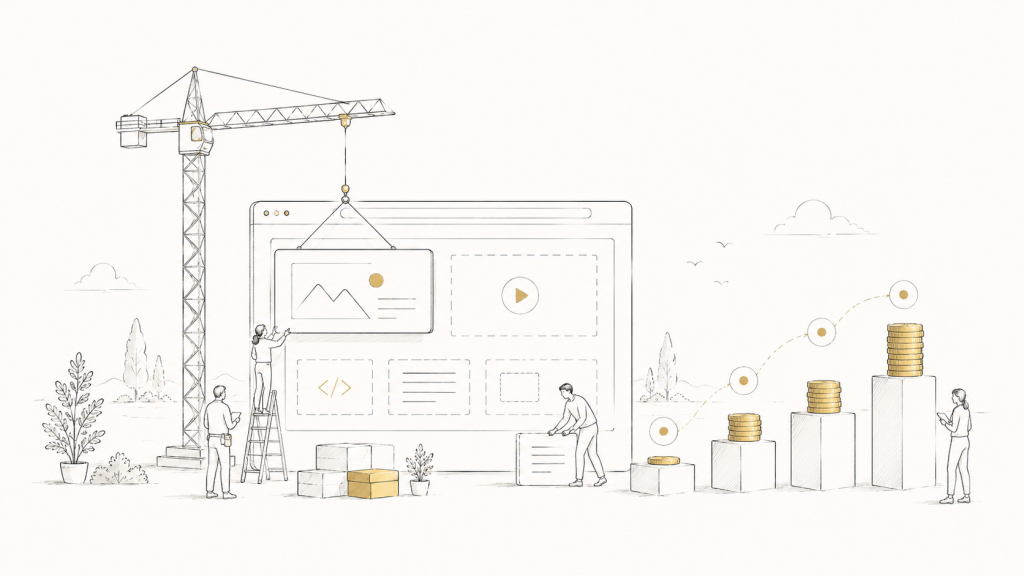
Imagine you have the best product in the world, but nobody knows it. You sell nothing. Marketing bridges "what you do well" and "the people who need it and would pay for it". It serves three purposes, in this order: getting people to know you (if they do not know you exist, they will not buy from you), to trust you (people buy from those they trust) and to choose you (when choosing between you and your competitors, the balance tips in your favour). Everything else — social media, adverts, SEO and email — is a tool serving those three purposes.
The real functions of marketing
- Attract: get the right people to come to you through SEO, social media, advertising and content.
- Convince: when they arrive, help them understand why you and build trust through branding, social proof and clear messaging.
- Convert: get them to take the next step with a website that sells, a clear offer and an easy way to get in touch.
- Retain: get clients to return and recommend you through email, service and follow-up.
- Differentiate: get people to choose you even when you are not the cheapest.
What marketing is NOT
Marketing is not just advertising — advertising is one part — nor is it showing off aimlessly on social media, or spending money on adverts and hoping for magic. It is not deception either: good marketing does not disguise a bad product; it connects it with people who value it. If you reduce marketing to "running adverts" or "posting things on Instagram", you miss almost everything it can really do.
Marketing for a small business
If you are self-employed or run a small business, you do not need a department or a huge budget. You need to be clear about who you are targeting, what makes you different and where your clients are so you can be there too. With that and a few well-chosen tactics — like those in the tool above — a small business can market itself more effectively than a large company trying everything. The key is not doing a lot; it is doing what is right for your objective.
I help you define who you are targeting, what makes you different and which tactics will achieve what you want, without spending on the wrong things. Thoughtful marketing, rather than following trends.
Let's talk about your marketingFrequently asked questions
Are marketing and advertising the same?
No. Advertising is a tool within marketing: the adverts you pay for. Marketing is the whole picture: understanding your clients, defining your proposition, choosing channels, converting and retaining clients. Advertising is one piece; marketing is the entire puzzle.
Does marketing work for a small business?
Yes, very much so. You need clarity rather than a big budget: who you are targeting, what makes you different and where your clients are. A focused self-employed professional can market more effectively than a large company trying everything without a strategy.
How much should I invest in marketing?
It depends on your sector and objectives, but what you invest in matters more than how much. Plenty of powerful marketing costs time rather than money: SEO, content and your Google Business Profile. Start with what delivers a measurable return and scale what works.
Is digital marketing different from traditional marketing?
The principles are the same — connecting an offer with a need and getting people to choose you — but the tools change. Digital marketing uses Google, social media, email and data to do the same work in a more measurable, targeted way. Strategy leads; digital puts it into practice.
Can you see marketing results?
Yes, if you measure them. Digital marketing's great advantage is that you can see what brings you clients and what does not. The mistake is failing to measure and relying on guesswork. Basic analytics shows you what works, so you can stop spending on what does not.
I am Rubén Romay, a marketing consultant in Mallorca. I help small businesses and self-employed professionals use marketing for what matters: getting people to know, trust and choose them. With strategy and data.
Chat on WhatsApp